
Pool Cue Joint Guide: Find Your Brand's Pin Type
Pool Cue Joint Compatibility Guide
This will help you find what selection to choose when you are looking for a replacement, spare, or shaft upgrade.
Important: Joint types can change across model years and product lines within the same brand. The joint pin/thread is only part of the fit. Pilot diameter, joint-face diameter, insert depth, pin length, and other dimensions can also matter. Use this guide as a starting point and, when possible, confirm the actual joint on your cue before ordering a replacement shaft.
Joint Types, In Plain English
| Joint Type | What It Looks Like | Important Compatibility Note |
|---|---|---|
| 5/16 x 18 | Thin pin with relatively fine threads; 18 threads per inch | A very common production-cue joint. Thread size alone does not guarantee that every 5/16 x 18 shaft will fit every cue. |
| 5/16 x 14 | Same nominal diameter as 5/16 x 18, but with 14 threads per inch | Common on many traditional American/custom cues. Piloted and flat-faced versions can differ. |
| 3/8 x 10 | Larger-diameter pin with deep, widely spaced threads | Common on many custom and production cues. Confirm the joint-face and pilot configuration as well. |
| 3/8 x 11 | Larger pin with 11 threads per inch | A distinct thread from 3/8 x 10. Do not treat 3/8 x 10 and 3/8 x 11 as interchangeable. |
| 3/8 x 14 | Larger-diameter pin with 14 threads per inch | Used by Cuetec and on some aftermarket shaft configurations. Joint-face diameter can also matter. |
| Uni-Loc Quick Release | Short, proprietary quick-release pin; locks with a partial turn | Uni-Loc QR is not interchangeable with McDermott QR, Viking QR, or other brand-specific quick-release systems. |
| Uni-Loc Radial | Distinctive fluted/radial-style pin | Radial and Uni-Loc Quick Release are different systems and require the correct shaft joint. |
| Pechauer Speed Joint | Pechauer's proprietary joint system | Do not assume a standard 5/16 x 14 shaft is automatically a correct Speed Joint fit. |
| Mezz Wavy / Wavy 2 / United | Proprietary Mezz joint geometry | Wavy, Wavy 2, and United are separate Mezz configurations. Select the exact joint required by the cue. |
| Brand-Specific Quick Release | Short or partially threaded pin designed for rapid assembly | McDermott QR, Viking QR, and other brand-specific systems are not automatically interchangeable with Uni-Loc. |
Brand-by-Brand Reference
| Brand | Common Joint(s) | Notes |
|---|---|---|
| Predator (after 2002) | Uni-Loc Quick Release or Uni-Loc Radial | The exact joint depends on the cue/model. Confirm whether the cue uses Uni-Loc QR or Radial before ordering. |
| Predator (before 2002) | 5/16 x 14 or 5/16 x 18 | Older Predator cues used threaded joints before the later Uni-Loc systems became standard. |
| McDermott | McDermott Quick Release or 3/8 x 10 | McDermott has used both its proprietary Quick Release and 3/8 x 10 configurations. Confirm the specific cue. |
| Viking | Viking Quick Release / 5/16 x 18 | Viking has used its own Quick Release system. Do not substitute a generic Uni-Loc shaft based only on appearance. |
| Mezz | Wavy, Wavy 2, United | These are different Mezz joint configurations. The cue must be matched to the correct Wavy, Wavy 2, or United shaft. |
| Cuetec | 3/8 x 14, 3/8 x 10, 3/8 x 11 and other configurations depending on model | Cuetec has used multiple joint configurations. Current Cynergy shaft offerings include several joint options, so verify the specific cue/model. |
| Pechauer | Pechauer Speed Joint, 5/16 x 14, Radial, 3/8 x 10, and Uni-Loc depending on configuration | Pechauer offers multiple joint configurations. Do not assume a cue uses the Speed Joint simply because it is a Pechauer. |
| Jacoby | 5/16 x 14, 3/8 x 10, Radial, and some Uni-Loc configurations | Confirm the exact joint on the cue. These systems are not interchangeable simply because they are made by Jacoby. |
| Schön | 5/16 x 14 | Schön commonly uses a piloted 5/16 x 14 configuration. The pilot/joint geometry is important in addition to the thread. |
| Meucci | 5/16 x 18 | Current Meucci cue and shaft specifications identify 5/16 x 18. Verify older or modified cues before ordering. |
| Joss | 5/16 x 14 | Common Joss configuration. Verify older, custom, or modified cues. |
| Joss West | 5/16 x 14, 3/8 x 10, Uni-Loc Quick Release, or Uni-Loc Radial depending on cue | Joint choice varies by cue. The exact pin and joint geometry should be confirmed. |
| Lucasi | Uni-Loc Quick Release or Uni-Loc Radial | The exact joint depends on the cue/model. Do not assume all Lucasi cues use the same Uni-Loc configuration. |
| OB Cues | 3/8 x 10 or 5/16 x 14 | Joint configurations vary by cue and product generation. Confirm the actual joint. |
| Players / Action / Dufferin | 5/16 x 18 | Common production-cue joint configuration. |
| Falcon | 5/16 x 14, Uni-Loc Quick Release, or 3/8 x 10 depending on cue | Falcon has used multiple joint systems. Confirm the exact cue before ordering a shaft. |
| Huebler | 5/16 x 18 | Older cues can have variations or modifications, so confirm the actual joint when possible. |
| Southwest | 3/8 x 11 | Distinct from the more common 3/8 x 10 joint. Do not substitute a 3/8 x 10 shaft. |
| Tiger | Uni-Loc Radial / Tiger-specific configurations depending on cue | Tiger joint configurations have changed over time. Verify the exact cue and production era. |
| Longoni | VP2 and other proprietary configurations depending on cue | Longoni uses specialized European joint systems. Confirm the exact model before ordering. |
| Becue | B-Loc | Becue's proprietary B-Loc system is not the same as other common quick-release systems. |
How to Identify a Joint You're Not Sure About
- Unscrew the shaft and look at the pin. Look for the actual pin and joint configuration rather than relying only on the cue brand. A thin threaded pin may be 5/16 x 14 or 5/16 x 18. A larger threaded pin may be 3/8 x 10 or 3/8 x 11. Quick-release systems require identification of the specific system.
- Count the threads or measure the pin. If you have calipers and a thread gauge, measuring the pin diameter and thread pitch can quickly distinguish common threaded joints. The difference between 5/16 x 14 and 5/16 x 18 is especially easy to miss by eye.
- Look at the joint face and pilot. Two cues can use the same nominal thread but still have different joint geometry. Check whether the joint is flat-faced or piloted, and compare the joint-face diameter and pilot dimensions when selecting a replacement shaft.
- Do not assume all quick-release pins are the same. Uni-Loc, Uni-Loc Radial, McDermott Quick Release, Viking Quick Release, Pechauer Speed Joint, Mezz Wavy/United and other systems may look similar but are mechanically different.
- When in doubt, send us a photo. A clear photo of the butt joint and shaft joint can often help identify the correct configuration. For older, custom, or modified cues, we recommend confirming the actual joint before ordering.
Looking for a replacement or low-deflection shaft?
Matching the joint pin is only the first step. The joint face, pilot, diameter, collar, and other dimensions may also need to match the cue. If you are unsure which shaft selection to choose, contact us before ordering and we can help verify the fit.
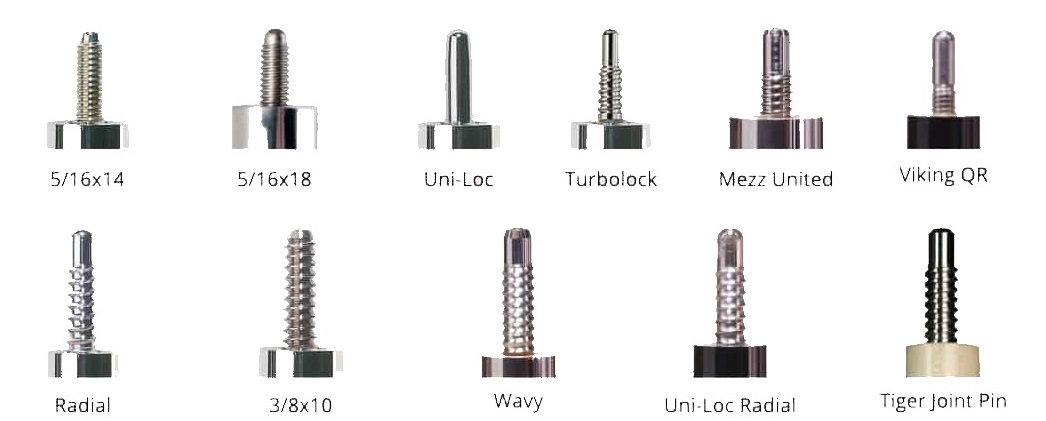
A lot longer list of brand pins can be found by clicking here
Return to Resource and Buying Guides
20.484